Tag: Career Advice

  • Understanding the Job Market in Toronto: Opportunities and Challenges

    Understanding the Job Market in Toronto: Opportunities and Challenges

    A friend of mine landed in Toronto recently, full of hope. She had two degrees, polished her resume, and started applying on the very first day. By the end of the week? Nothing but auto-replies. You know the ones, “Thanks for applying, but…”

    She was shocked. She kept asking me, “Why is it so hard to get a response when I know I’m qualified?”

    Here’s the thing no one really tells you until you’re already frustrated: The Toronto job market isn’t broken, but it does have layers. And if you don’t know how to navigate them, especially as a newcomer, you end up feeling invisible.

    Not to hand you the usual “apply through LinkedIn or Indeed” advice (which works, but only 10% of the time), in this blog, we will be showing you the real structure of the market. The unspoken norms. The referral-first culture. The timing tricks, the startup shortcuts, and the survival mindset that help you thrive when you’re not born into the network.

    Toronto Employment View

    A. Top Hiring Sectors & Growth Areas

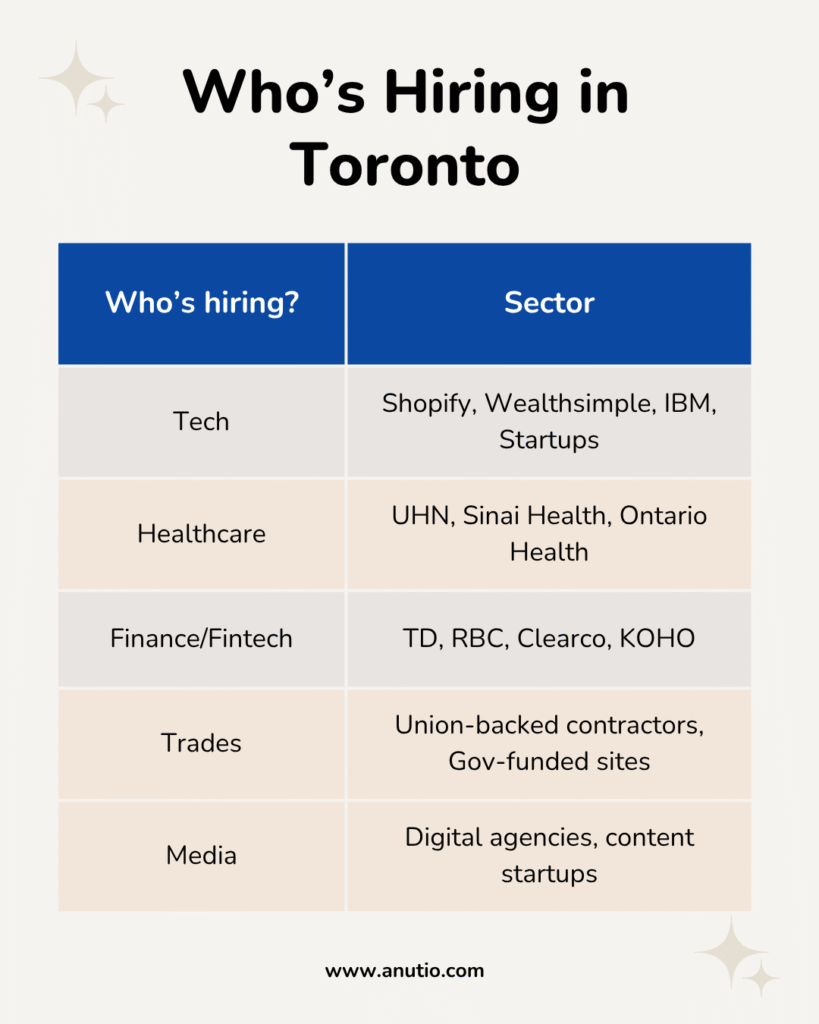
    Toronto is still one of the most opportunity-rich cities in North America, but you need to know where to look. The industries hiring right now aren’t always the ones we assume.

    Here are the sectors pulling in talent across the board:

    Tech

    From AI startups to global giants like Shopify, Microsoft, and Google’s Sidewalk Labs (RIP but replaced), tech is booming. The city’s tech workforce has grown by over 40% in the last five years, and demand hasn’t slowed.
    Roles in:

    • Cloud infrastructure
    • Data engineering
    • AI/ML
    • DevOps
    • Frontend + backend (React, Node, Python, Go)

    Healthcare

    Post-COVID, Toronto’s health sector is hiring constantly, especially:

    • Nurses
    • PSWs
    • Lab techs
    • Health informatics experts (if you’ve got tech + healthcare, jackpot)

    Finance & Fintech

    Bay Street may look old-school, but fintech startups are popping up weekly.

    • Financial analysts
    • Risk & compliance
    • Data-heavy roles in blockchain, credit scoring, and lending platforms

    Skilled Trades

    Electricians, HVAC technicians, plumbers, and construction supervisors are consistently in demand.
    And yes, these jobs pay very well, often better than entry-level office roles.

    Creative + Digital Media

    Digital marketing, UX/UI, video content, and paid media specialists are in high demand, especially at agencies, e-commerce companies, and small businesses.

    Quick breakdown:
    B. Hiring Cycles & Seasonality

    Timing can make or break your job search.

    Peak hiring months:

    • January to March – budgets reset, new roles open
    • September to early November – post-summer rush to fill roles before year-end

    Slow periods:

    • Summer (July–Aug) – people are on vacation, hiring slows
    • Mid-November to December – companies wind down for the holidays

    Recruiters on Quora mention they’re less responsive during slow seasons, not because you’re unqualified, but because internal processes slow down or freeze. Use those quiet months to prep.

    • Redo your resume
    • Build projects
    • Grow your LinkedIn
    • Do informational interviews (people have more time!)

    C. The Education vs. Skills Debate

    In Toronto, your degree will get your foot in the door, but it won’t get you the job. You’ll find dozens of posts from international grads and immigrants saying:

    “I have a Master’s, and I still couldn’t get interviews.”
    “Local employers keep asking for experience, not just education.”

    But here’s what employers care more about:

    • Local experience
    • Portfolio or project outcomes
    • Communication and cultural fit
    • Soft skills: time management, teamwork, problem-solving
    • Your ability to jump in and contribute immediately

    They want proof that you can work, not just study. That means:

    • Volunteer or freelance work counts
    • Open-source contributions help
    • Side projects can tip the scale
    • Certifications with practical projects matter more than long lists of degrees

    Don’t lead with your education. Lead with what you’ve done. Then let your education support it.

    Challenges for Immigrants & International Graduates

    Moving to Toronto and arriving with diplomas from back home? You’re in great company. But here’s the reality: it’s not always smooth.

    A. Credential Recognition

    First off: those shiny overseas degrees often don’t carry the same weight here.
    HR managers and recruiters see a University of Toronto diploma, and they get it. A degree from elsewhere? They may need convincing.

    What to do:

    • Use credential evaluators like WES or ICES right away. That gives your resume context.
    • Include phrases like “Canadian-equivalent education” once your evaluation arrives.
    • Add any local short courses—bootcamps, Certs, microcredentials—to reinforce that you’re current.

    B. The Experience Paradox

    You need Canadian experience to get a job, but you need a job to get Canadian experience. Right?

    What works is strategic:

    • Volunteering with organisations—like HackTO, local charities, even school tech clubs—counts.
    • Internships, even unpaid or contract, open doors.
    • Short-term freelance projects that solve local problems? Gold.

    These help you list “Toronto experience” on your LinkedIn and resume. HR will take a second look.

    C. Overcoming Bias & Building Networks

    Even with the right credentials, it’s harder to break in without connections.
    You may face accents, communication style differences, or cultural misunderstandings. That’s not on you, it’s a system issue. What matters is how you adapt.

    Pro tips from immigrants on Quora and Reddit:

    • Speak clearly, even if you’re not 100% accent-free.
    • Show cultural curiosity—understand Canadian workplace norms (meetings, email tone, etiquette).
    • Be proactive: ask for coffee chats rather than a cold application.
    • LinkedIn and Slack active participation = visibility and referrals.

    Hiring managers often say they’re looking for adaptability and coachability. Show that you can “flip the switch” by understanding local expectations.

    D. Licensing & Regulation

    If you’re a nurse, teacher, accountant, or in finance, don’t underestimate the licensing piece. It can take months or even years.

    Action plan:

    • Start early with bridging programs (like Ryerson for teachers or CNA for finance)
    • Look for accelerated streams—they exist, though harder to find
    • If you’re in education, get your letter from the Ontario Teachers’ Federation
    • Healthcare workers—consider bridging roles or PSW work first

    The faster you qualify, the sooner you can actually work in that field.

    Toronto’s Hidden Job Market

    You’ve probably applied to 100 postings already. Still nothing. That’s because 70–80% of jobs are never public; they live in networks and communities.

    A. Referral & Community-Based Hiring

    Most Canadian hires happen via referrals or internal hires. Companies are safer hiring someone people already vouch for.

    How to tap in:

    • Go to local meetups—TechTO (tech), charity boards, even fitness events with entrepreneurs
    • Slack/Discord communities for Toronto tech groups—they’re gold
    • Start with comment engagement. Then ask for an intro, share a project, and build trust

    B. Personal Branding in Toronto

    Here’s the difference between good candidates and great ones: visibility.
    A filled-in “About” section on LinkedIn that includes your city, a friendly headshot, and your current learning projects? That’s how recruiters find you.

    Feature:

    • Projects with local context
    • Volunteer roles in your communities
    • Hackathon + open source contributions

    Toronto employers love seeing you plugging into the ecosystem.

    C. Targeted Networking

    Sending resumes to jobs@ is easy, but it rarely works. Instead, focus on strategic networking:

    • Alumni associations—from your alma mater or bootcamp often host events in Toronto.
    • Professional associations like CPA Ontario or PMINTO host free or low-cost sessions.
    • Lean into professional seminars and workshops—even virtual ones can be Toronto-only.

    Goal: meet someone who can vouch for your fit. A real human, not a bot.

    Opportunities in High‑Demand Sectors

    Toronto’s not just big, it’s diverse. Let’s break down the industries that offer real chances, and how YOU can get in.

    A. Tech & Startups

    The tech landscape here is booming. From massive players to AI and green-tech startups, opportunities are everywhere.

    What’s hot right now:

    • Cloud and DevOps: AWS, Azure, GCP skills in massive demand
    • AI/ML/Data: massive infrastructure and analytics teams at Shopify, DeepMind
    • Full-stack (Node, React, Python): Startups love someone who can cover both ends

    Why startups are worth attention:

    • Less rigid titles “developer” might mean working on design, infrastructure, or user interviews
    • Grants and incentives (like IRAP and SR&ED) push startups to hire quickly

    Insider advice:

    • Look up startups funded in the last 2 years—these are in growth mode
    • Mention familiarity with grant programs in your applications
    • Your freelance or side project work absolutely counts here—show it off as applicable experience

    B. Healthcare & Wellness

    Toronto’s health scene is hiring for both traditional and emerging roles:

    • Nursing, PSWs, Lab Technicians—high demand continues post-COVID
    • Health Informatics—beautiful blend of healthcare + data (expect C$70K–C$100K)

    Strategy tip:

    • If you come from a clinical background, a Health Informatics certification takes weeks and opens tech doors
    • If you have tech skills, pair them with volunteer work in health organisations or even with APIs that integrate health data

    C. Skilled Trades & Green Jobs

    This is sometimes overlooked, but trades are consistently high-paying and in high demand.

    • Electrical, plumbing, and HVAC trade unions are actively sponsoring newcomers
    • Renewable energy work—solar panel installation, EV charger setup is growing

    Steps to break in:

    • Explore apprenticeships and ask about sponsorship for certification
    • Even part-time clean energy projects or EV setups look solid on a future-forward resume

    D. Finance & Fintech

    Bay Street meets blockchain here in Toronto.

    • Roles: Financial analysts, Compliance, Data roles, Blockchain
    • Fintech firms: Wealthsimple, Koho, Borrowell, etc.

    What ups your chances:

    • Certifications like CFA, CPA, or PFP—available via Canadian bodies or night-school options
    • Tech skills and certifications (Excel, SQL, Python → quantitative roles)
    • Show involvement in local fintech communities—attend pitching nights or fintech meetups

    E. Digital Marketing & Creative Tech

    Who says Toronto isn’t digital? Agencies and startups need:

    • SEO / SEM / PPC specialists
    • Content creation, digital storytelling, and video editing
    • UX / UI design roles paired with marketing experience

    What lands interviews here:

    • Project-based portfolios with real campaign outcomes
    • Certifications (like Google’s Digital Marketing certificate)
    • Freelance or agency background? Feature it proudly, especially if you generated real results

    Overcoming Hiring Hurdles: Career‑Tactics Toolbox

    Here are laid‑out tools to overcome hurdles in Toronto’s competitive job market.

    A. Resume & ATS Optimisation

    Toronto’s resume format is simple but specific:

    • Stick to 1 page unless you’ve got 10+ years experience
    • Use Canadian English (labour, centre, colour!)
    • Include location and “Immigration status: Eligible to work in Canada” if applicable

    Mirror the job description. If it says “AWS, Kubernetes, Terraform”, you need those exact words.

    Tools: Jobscan, Resume Worded, Grammarly

    B. Interview Prep

    Different roles, different stages:

    • Panel interviews are common at banks and startups – 3–5 people, technical + cultural questions
    • Behaviorally, they want stories, use STAR (Situation, Task, Action, Result)
    • Show cultural fit: The Canadian workplace relies on collaboration, communication, and adaptability

    Toronto nuance: Business casual, punctuality, introductory small talk, being polite and clear go a long way

    Show your work: Bring portfolios, screenshots, or demo apps. Don’t be shy, be confident in what you’ve built.

    C. Building Local Experience Quickly

    You’ve got to dig in:

    • Volunteer: Hackathons, charity boards, tech associations
    • Co-op: Several colleges offer paid co-op placements for newcomers
    • Contract gigs: Even low-paid short-term projects count. List them clearly on LinkedIn and CV
    • Side projects: Open-source contributions show drive and self-learning

    These activities get resumes past “no local experience” filters.

    D. Government Resources & Supports

    Toronto offers great programs:

    • Job Bank, Employment Ontario, Immigrant settlement services
    • Canada-Ontario Job Grant, Digital Adoption Program: employers can get training costs covered if you know about it
    • Settlement agencies like COSTI, ACCES Employment—free resume reviews, interview help, job fairs

    Tip: Mention this in interviews. It shows you’re informed—and it’s often a hidden bonus.

    E. Mentorship & Coaching

    You aren’t alone. These resources help:

    • All immigrant-serving mentorship programs: Access Employment, Ryerson Hub
    • Startup mentorship from #YSL, #NEXT Canada
    • Peer coaches shared in Reddit threads (people actively doing this, zero-cost)

    Tactic: Apply early to community mentorship cohorts—they often accept small side projects or pair international grads with local mentors.

    Navigating the Gig / Freelance Economy

    Toronto’s gig economy is growing fast, and it’s not just about Uber or DoorDash. In 2022, some 624,000 Canadians reported gig work as their main job, while nearly 1.5 million took on freelance side gigs.

    Why Freelance Is a Smart Entry Point

    • Flexible cash flow while you job hunt
    • Real-world experience to counter the “no Canadian experience” label
    • A bridge to full-time. Many clients turn into referrals or outright hires

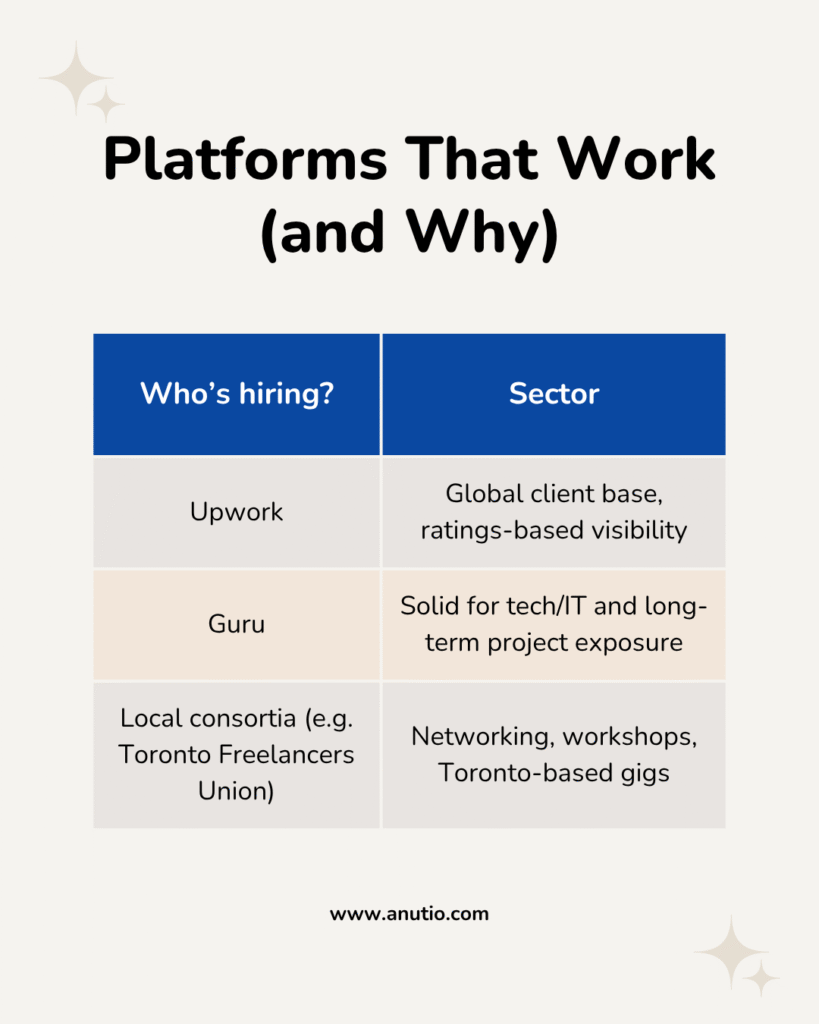
    Platforms That Work (and Why)
    From Freelance to Full-Time

    • Showcase local problem-solving in your portfolio (ex, “Helped a Toronto bakery modernise their online ordering via React”)
    • Request referrals from clients or partners
    • Transition smoothly by demonstrating reliability, punctuality, and communication in your freelance contracts. Many SMEs convert reliable freelancers into full-time hires

    Emerging Trends & Future Outlook

    Toronto is shifting beneath our feet, and future trends matter if you want to stay ahead.

    A. AI + Green Economy = Major Hiring Boom

    Ontario saw 17,000+ new AI jobs in 2024–25, more than doubling last year. Over 70 AI startups launched in Toronto alone. The government is also rolling out billions in incentives for AI-powered green data centres.

    B. Remote/Hybrid Work

    About 78% of Toronto office workers are now operating under hybrid arrangements. And 81% of Canadians support flexible work models .

    What it means for you:
    You can live in Hamilton or Ottawa, but land Toronto-based roles, just show strong remote work discipline and results.

    C. Economic Indicators & Government Support

    Actionable Roadmap

    Here’s your 12-week plan to go from “just landed” to “working in Toronto”:
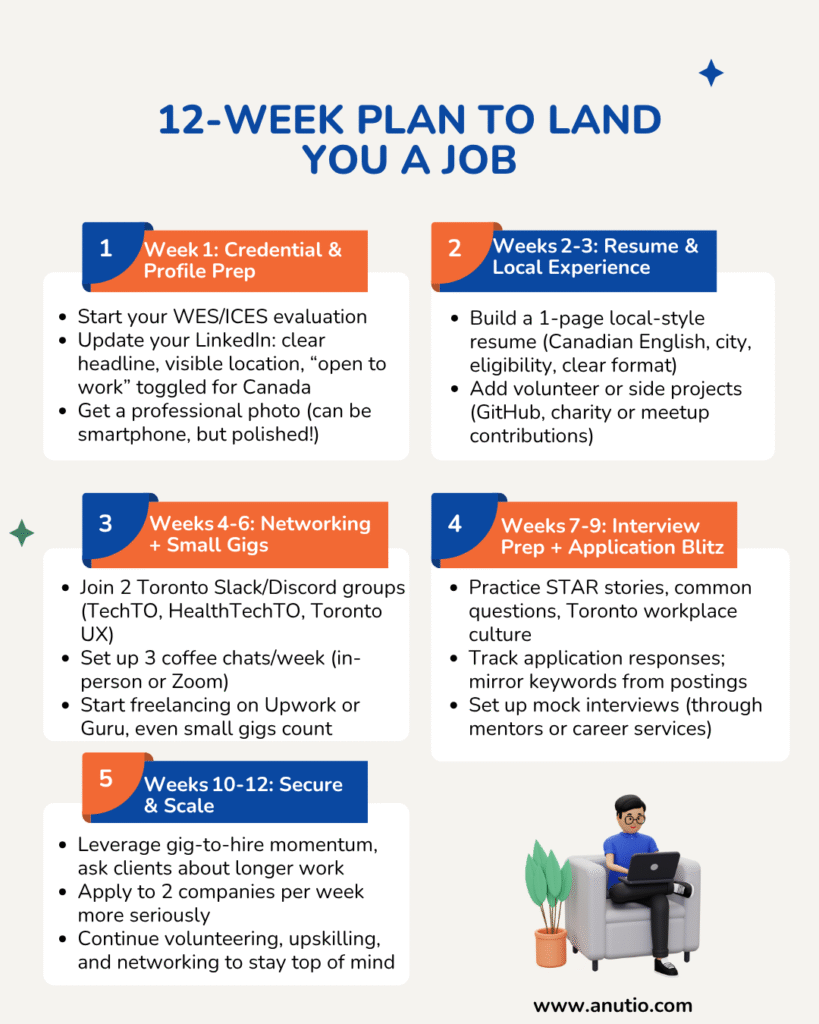
    Tools:

    • Roadmap template (.doc, .pdf) with checkboxes
    • Sample message scripts for LinkedIn/reach-outs
    • Resume layout in Google Docs

    Conclusion

    The immigrant advantage isn’t your past; you earn it by plugging into local networks, showcasing real work, and adapting quickly.

    With resilience, adaptability, and strategy, you won’t just find a job, you’ll build a career here.


  • The Most In‑Demand Skills in Toronto’s Job Market (2025 Update)

    The Most In‑Demand Skills in Toronto’s Job Market (2025 Update)

    Toronto’s job market is booming. Whether you’re eyeing top tech roles, healthcare, trade work, digital marketing, or project management, knowing which skills are in high demand is critical.

    In 2025, local employers are looking for professionals with real-world experience in areas like cloud computing, AI, data engineering, nursing, welding, social media marketing, and agile project oversight. They want hybrid skills, not just one-off certifications. That means cross-domain expertise, for example, cloud security for healthcare or data analytics for marketing.

    Tech: Cloud, AI & Data

    What’s Trending

    From startups to enterprise giants, Toronto is hungry for tech pros, especially those fluent in cloud infrastructure, AI systems, and big data pipelines. A Robert Half report names roles like AI/ML engineers, data engineers, DevOps, and cloud and network/security engineers among the top 15% most in-demand jobs.

    Toronto has over 314,100 tech workers, a 44% increase in five years. It’s ranked 4th in North America for tech talent.

    Salary Ranges

    Based on 2025 Ontario data:

    • Cloud Engineers: C$90K–C$115K (mid-level); up to C$175K+
    • AI Engineers: avg. C$156,138/yr (~C$75/hr)
    • Data Engineers: typically C$110K–C$160K

    Learning Resources

    • Cloud: AWS Arch Associate, Azure Fundamentals, Google Cloud Architect
      • Free: AWS Skill Builder, Microsoft Learn
      • Paid: A Cloud Guru, Coursera
    • AI/ML:
      • Free: Google ML Crash Course, DeepLearning.AI’s introduction
      • Paid: Coursera AI for Everyone, Udacity AI Nanodegree
    • Data:
      • Free: Data Engineering Zoomcamp, Mode SQL Tutorial
      • Paid: Coursera Data Engineering Specialisation

    Build demo cloud scripts or mini-ML projects to showcase on GitHub. Use these in profiles or proposals for credibility.

    Healthcare

    Trending Roles

    With demographic growth and recovery from COVID-19 pressures, registered nurses (RNs) and lab technicians remain highly sought after.

    Salary Ranges

    • Registered Nurses: ~$37.50/hr (C$78K/year)
    • Lab Techs and Other Roles: Typically C$50K–C$70K annually

    Where to Learn

    • Basic Programs: George Brown College, Humber College
    • Certification: Ontario College of Nurses, Canadian Society for Medical Laboratory Science
    • Upskill Option: Add health informatics so you can bridge into Tech + Healthcare roles

    Trades

    Roles such as electricians, plumbers, welders, and HVAC techs are vital for Toronto’s construction and infrastructure boom.

    Salary Ranges

    • Electrician: ~C$40/hr (~C$80K/year)
    • Other Trades: C$50K–C$90K/year depending on certification and specialisation

    Where to Learn

    • Apprenticeships via Skills Canada, local unions, and community colleges
    • Certification through the Ontario College of Trades
    • Upskill Programs: Advanced electrical systems, green retrofit training

    Digital Marketing

    Trending Roles

    As businesses double down on digital presence, roles like SEO specialist, social media manager, and PPC analyst are booming.

    Salary Ranges

    • Marketing Specialist: ~$34/hr (~C$70K/year)
    • Senior Digital Marketers: C$80K–C$120K

    Where to Learn

    • Free: Google Digital Garage (Fundamentals), HubSpot Academy
    • Paid: Coursera Digital Marketing Specialisation, BrainStation
    • Marketplace: Twitter, LinkedIn courses from Canadian marketing associations

    Project Management

    Trending Roles

    From IT rollouts to construction and trades, PMs are essential across sectors.

    Salary Ranges

    • PMs: ~$44/hr (~C$90K/year)
    • IT Project Managers: C$90K–C$130K+

    Where to Learn

    • Foundation: PMP, Certified ScrumMaster (CSM), Prince2
    • Skills Upgrade: PMI, Coursera, edX courses in Agile & Waterfall

    Emerging Insights & Skill-Based Signals

    • Skill-based hiring is on the rise in Toronto. Employers increasingly reward demonstrable skills over traditional degrees, especially in AI and green tech positions.
    • Compensation premiums in AI/ML (+35%) or cybersecurity (+28%) are real.
    • Tech jobs like software development and data analysis continue to dominate job creation, with 95,900 added over 5 years in Toronto.

    How to Build These Skills Effectively

    1. Pick Your Core + T-shape Skill
      • Example: Cloud + healthcare informatics → opens hybrid roles
    2. Get Certified & Build Projects
      • Use AWS/GCP/Azure certs and create a portfolio.
    3. Showcase & Network
      • Add skills to LinkedIn, build case studies
      • Volunteer in community groups or projects to gain cross-sector visibility
    4. Continuous Learning
      • Toronto-based meetups: TechToronto, HealthTechTO, TradeShows
      • Online events hosted by Toronto’s coworking spaces

    Conclusion

    In 2025, Toronto rewards professionals with diverse, hybrid skills, especially those who can blend cloud + AI + industry knowledge. Healthcare, trades, marketing, and PM roles are equally in demand and well compensated.

    1. Identify your target skill area
    2. Choose the right learning path
    3. Build real, demonstrable projects
    4. Showcase your skills across your resume, LinkedIn, and portfolios
  • Top Resume Mistakes That Keep You Out of FAANG Companies (and How to Fix Them)

    Top Resume Mistakes That Keep You Out of FAANG Companies (and How to Fix Them)

    You’ve been applying. Again and again. You know you’ve got skills; maybe you even freelance, contribute to open source, or just finished a solid bootcamp.

    But after some months, there have been no callbacks. And then the doubt creeps in: “Maybe I’m not good enough.” Sometimes, the issue isn’t your experience; it’s how you’re presenting it.

    Top companies like Google, Meta, Amazon, Microsoft, and Apple (aka FAANG) don’t just look for raw skills. They look for clarity, impact, and intent and your resume is your first audition.

    There are several resume mistakes that silently kill your chances at FAANG interviews and in this article we’ll teach you how to fix them.

    Your Resume Reads Like a Job Description — Not a Story of Impact

    The mistake:
    Copy-pasting your responsibilities instead of showing what you actually accomplished.

    Bad example:

    “Developed APIs in Node.js and maintained backend systems.”

    Okay… but what did it do? What changed because of you?

    The fix:
    Write your bullet points using this simple formula:
    Action → Result → Tool/Method

    Great example:

    “Built and deployed 7+ RESTful APIs using Node.js and MongoDB, improving platform response time by 30% and enabling seamless integration with frontend systems.”

    Use numbers. Impact quantified is impact proven. Even if you’re a freelancer, estimate metrics like load times, user growth, reduced errors, etc.

    You Lead with Tools Instead of Outcomes

    The mistake:
    Starting every bullet with “Used React…,” “Worked with AWS…,” “Built in Python…”

    These are tools, not results.

    The fix:
    Flip it. Lead with what you did, then mention the tools that made it happen.

    Example:
    “Used React to build frontend interfaces”
    “Redesigned checkout flow, reducing cart abandonment by 18%, using React and Tailwind”

    You’re Using a Single Generic Resume for All Applications

    The mistake:
    One-size-fits-all resumes — especially for FAANG — usually land in the black hole.

    The fix:
    Tailor your resume to the role. Every. Single. Time.
    How?

    • Mirror keywords from the job description
    • Emphasise the experiences most relevant to that job
    • Highlight projects that match their tech stack or business goals

    Tool: Use Jobscan or Resume Worded to compare your resume to the job posting.

    Create a “core resume” with 100% of your wins. Then make quick edits per job.

    No Quantified Achievements = No Credibility

    The mistake:
    You list what you did, but not how well you did it.

    The fix:
    Include numbers in at least 60–70% of your resume bullets.

    • Did it save time?
    • Improve speed?
    • Reduce errors?
    • Boost signups, usage, or revenue?

    Even estimates work. Don’t have hard data? Approximate:

    “Improved API response time by ~40% based on user testing.”
    “Handled 50+ support tickets/month with a 90% satisfaction rate.”

    If you’re freelancing → include client feedback, retention rates, and timeline success.


    You’re Not Talking Like a Problem Solver

    The mistake:
    You focus only on tasks, not the problems you solved or why they mattered.

    The fix:
    Frame your experience through the lens of:

    • What problem did you tackle?
    • What was the challenge?
    • How did your work change things?

    Example:

    “Reduced mobile app crashes by 70% by identifying memory leak in React Native component used across 3 key features.”

    FAANG loves initiators and debuggers. Highlight when you identified issues or led improvements.


    Your Resume Has Fluff Phrases and Filler Words

    The mistake:
    Using space-wasters like:

    • “Hardworking individual who…”
    • “Team player with excellent communication skills…”
    • “Self-starter and quick learner…”

    FAANG recruiters read 500+ resumes a week. They don’t need character bios — they need evidence.

    The fix:
    Replace fluff with facts:
    “Team player who collaborates well.”
    “Led cross-functional sprint planning with designers, PMs, and QA across 4 releases.”

    Let your actions show your soft skills. Don’t state them outright.

    You’re Overlooking Your Freelance / Contract Work

    The mistake:
    Treating freelance projects like side notes or lumping them under “Other Experience”.

    The fix:
    Feature your freelance roles like you would full-time ones.
    Include:

    • Scope of the project
    • Tech stack used
    • Business outcome
    • Client testimonial (if available)

    Example:
    Frontend Developer (Freelance)

    Built a responsive dashboard for a US-based healthcare startup, reducing admin time by 25%. Used Vue.js, Firebase, and Chart.js.

    Freelance work shows initiative, time management, and product focus, highlight that proudly!

    The Formatting is… Not Helping You

    The mistake:

    • Dense paragraphs
    • Inconsistent spacing
    • Weird fonts
    • Confusing sections

    If it looks hard to skim, it’s probably being skipped.

    The fix:
    ✅ One full page for most candidates (two max if you’re experienced)
    ✅ Clear section headers: Experience, Skills, Projects, Education
    ✅ Use bullet points (not paragraphs)
    ✅ Stick to clean, readable fonts. Arial, Calibri, Helvetica, Roboto
    ✅ Save as PDF unless told otherwise

    Use Standard Resume, Resume.io, or a clean Google Docs template.

    You’re Hiding Your Best Work in a Project Graveyard

    The mistake:
    Listing projects with vague descriptions like:

    “Built a chatbot in Python.”
    “Created a todo app using React.”

    The fix:
    Turn it into a story of value:

    • What did it solve?
    • Who was it for?
    • How did it grow your skills?

    Better example:

    “Created a WhatsApp-based chatbot to automate customer queries for a local business, reducing manual support by 80%.”

    Link to GitHub, live demo, or case study where possible. Show, don’t just tell.

    You Think the Resume Is Just a Box to Check

    The mistake:
    Thinking your resume is just something you toss in with an application.

    The fix:
    Your resume is your first pitch, your elevator story, your ad copy.

    It should:

    • Make someone want to talk to you
    • Get you in the room
    • Show you’re ready for their problems

    Revisit your resume every 2–3 months. Keep it fresh, relevant, and focused on where you want to go, not just where you’ve been.

    Your Next Step?

    Getting into Google, Amazon, Meta, Microsoft or even startups is not about being perfect — it’s about showing that you:

    • Solve problems
    • Deliver results
    • Communicate clearly
    • Care about impact

    Your resume should be proof of all four.

    If you follow even half of these fixes, you’ll already be ahead of 80% of applicants.

    Now what?

    • Block 2 hours this week to fix your resume.
    • Use a tool like Jobscan or Anutio to tailor it and find the existing gaps in it.
    • Share your updated resume with 2 peers for feedback.
    • Apply smarter—not just harder.

  • What to Study to Land a Job at Google, Microsoft, or Amazon

    What to Study to Land a Job at Google, Microsoft, or Amazon

    Most of the time, scrolling on LinkedIn or Twitter meets you with several success stories like
    “Just landed my offer at Google/Microsoft/Amazon!”

    And the first thing that comes to your mind:

    What exactly did they study?
    What skills are these companies really looking for?
    Where should I even start?

    One of the most common questions we hear from aspiring tech professionals and freelancers looking to land full-time roles is “What do I actually need to learn to stand out at companies like Google, Microsoft, or Amazon?”

    And the honest answer is that there’s no single “golden” curriculum, but there is a clear set of skills and areas that consistently get valued.

    Keep reading to find out how to make a clear path for yourself.

    Why Study Paths Matter for Top Tech Companies

    It’s tempting to think, “If I just get really good at LeetCode, I’ll land the job.”
    But that’s only part of the puzzle.

    According to LinkedIn’s Emerging Jobs Report, hiring managers at top companies are increasingly looking for well-rounded candidates who bring:

    • Strong coding fundamentals
    • Practical system-building skills
    • Communication and collaboration abilities
    • Business awareness – understanding how tech drives value

    Certifications help, but depth of skill matters more.
    Degrees help, but projects and problem-solving matter more.

    Core Areas to Study

    Here are some topics per category to study if you want to land interviews and succeed at Google, Microsoft, or Amazon:

    Data Structures & Algorithms

    You can’t skip this, especially for Google and Amazon.
    Both companies put a heavy emphasis on your ability to solve problems efficiently.

    Study topics:

    • Arrays & Strings
    • Linked Lists
    • Stacks & Queues
    • Hash Maps & Hash Sets
    • Trees & Graphs (very important!)
    • Dynamic Programming
    • Recursion & Backtracking
    • Sorting & Searching

    Resources:

    Tip: For Amazon and Google, focus on optimising for time & space complexity in interviews.

    Systems Design

    Microsoft, Amazon, and Google love candidates who can design scalable systems, even for junior-mid roles now.

    Study topics:

    • Load Balancing
    • Caching
    • Database Design (SQL + NoSQL)
    • Microservices
    • CAP theorem
    • Event-driven architectures
    • Data consistency and availability
    • High availability & fault tolerance

    Resources:

    Tip: Freelancers working with startups can get real-world experience with system design → mention this in interviews!

    Coding Fundamentals

    Top tech companies expect you to know a mainstream language deeply (Java, Python, C++, Go, TypeScript)

    Core language concepts:

    • Memory management
    • Object-oriented programming
    • Functional programming basics
    • Multithreading/concurrency

    Resources:

    • Language-specific books & official docs (ex: Effective Java, Python Cookbook)
    • Open-source projects in your target language
    • Exercism.io for hands-on language practice

    Tip: Don’t jump between 5 languages. Pick 1–2 and go deep.

    Cloud & Distributed Systems (Bonus: Critical for Freelancers too!)

    More and more interview loops now ask about cloud architecture and working with distributed systems.

    Study topics:

    • AWS, Azure, or GCP basics
    • Containerization (Docker)
    • Kubernetes basics
    • Serverless computing
    • CI/CD pipelines

    Certifications that help:
    AWS Certified Solutions Architect
    Google Professional Cloud Architect

    Data Engineering & Big Data (Increasingly Important)

    Amazon and Google especially value data-savvy engineers, even in general SWE roles.

    Study topics:

    • ETL pipelines
    • Data modeling
    • Distributed data systems (Hadoop, Spark)
    • SQL optimization
    • Data visualisation basics

    Resources:

    Soft Skills & Behavioural Prep

    One of the most underrated “study” areas is your ability to communicate and collaborate.

    Study topics:

    • STAR method for behavioural questions
    • Conflict resolution
    • Working in cross-functional teams
    • Giving and receiving feedback
    • Leadership principles (especially critical for Amazon!)

    Resources:

    How to Structure Your Learning

    One mistake many candidates make is trying to study everything at once.

    Instead, think of your learning path in layers:

    LayerFocusTime Allocation
    FoundationCoding fundamentals, DSA40%
    System ThinkingSystem design, cloud25%
    Domain SpecializationData engineering, ML, security, etc.15%
    Behavioral & Soft SkillsInterview prep, leadership10%
    Freelance & Portfolio ProjectsReal-world experience10%

    Adjust percentages based on your experience level and target role.

    Conclusion

    If you’re serious about landing a job at Google, Microsoft, or Amazon, study smart, not just hard.

    Prioritize:

    • Strong coding fundamentals + algorithms
    • Scalable system design
    • Practical cloud skills
    • Data engineering basics
    • Soft skills + leadership

    And if you’re freelancing, leverage every project as a learning opportunity and portfolio booster.

    The tech hiring process rewards those who can apply knowledge to real problems, not just memorise algorithms.

    So as you study:

    • Build projects
    • Share your learning in public (LinkedIn, GitHub)
    • Stay curious and consistent

    Your next interview invite could be one study session away.

  • 5 Certifications That Will Make You Stand Out to Top Tech Employers

    5 Certifications That Will Make You Stand Out to Top Tech Employers

    You’re scrolling job posts from Google, Meta, Microsoft, Shopify, Stripe — and everywhere you look, you see the same thing:

    “Cloud experience required.”
    “Security certifications preferred.”
    “Proven skills in data engineering, DevOps, or machine learning.”

    And then you wonder:

    Do I need more credentials to stand out?
    If so, which certifications are actually worth it — and which ones are just fluff?
    How do I choose the right certification if I’m balancing freelance work or starting my tech career?

    Here’s the deal: Certifications don’t guarantee you a job — but the right ones can absolutely help you:

    • Signal serious intent to recruiters
    • Build in-demand technical skills
    • Open doors to freelance opportunities and full-time tech roles
    • Show that you’re staying current in fast-changing fields like cloud, AI, and security

    Why Certifications Matter (and Where They Fit)

    Before we get to the list, let’s get one thing clear:
    Certifications alone won’t land you a job at a top tech company.

    But — they can bring a new phase in these cases:

    • You’re transitioning careers into tech and want to validate your skills
    • You’re a freelancer looking to unlock higher-paying tech contracts
    • You want to specialize in fast-growing areas like cloud, AI, cybersecurity, or data
    • You want to stand out in a crowded field of applicants

    According to a Global Knowledge survey, 76% of IT decision-makers believe that certified staff are more productive and deliver better results.
    (Source: Global Knowledge 2023 IT Skills and Salary Report)

    And in many hiring processes — especially for cloud, AI/ML, security, and DevOps roles — a respected certification can help your resume:

    • Pass through applicant tracking systems (ATS)
    • Catch the attention of technical interviewers
    • Help you show credibility even if you don’t have a traditional CS degree

    5 Certifications That Will Make You Stand Out to Top Tech Employers

    Google Professional Cloud Architect

    If you want to work with Google Cloud Platform (GCP) — or just be highly employable in cloud architecture roles across the industry — this is one of the top cloud certs you can get.

    Why it stands out:

    • Designed by Google for real-world cloud architects
    • Signals strong understanding of GCP architecture, security, compliance, and scalability
    • Valued at Google, Meta, Spotify, Twitter, and many cloud-first startups

    Great for:

    • Aspiring cloud engineers
    • Freelancers building cloud-based applications
    • Developers transitioning into DevOps or cloud architecture roles

    More info: Google Professional Cloud Architect

    AWS Certified Solutions Architect – Associate

    Amazon Web Services is still the #1 cloud provider globally — and AWS Certified Solutions Architect remains one of the most respected certifications across tech hiring.

    Why it stands out:

    • Demonstrates knowledge of designing scalable, highly available, and fault-tolerant systems on AWS
    • Recognized by almost every tech employer — Google, Meta, Microsoft, Amazon, Netflix, Airbnb, and more
    • Opens freelance contract opportunities for AWS migrations and optimizations

    Great for:

    • Cloud engineers
    • Software engineers looking to add cloud to their toolkit
    • Freelancers who want to offer AWS-based solutions

    More info: AWS Solutions Architect – Associate

    Certified Kubernetes Administrator (CKA)

    If you want to work in DevOps, cloud-native architecture, or site reliability engineering (SRE) — Kubernetes skills are hugely in demand.

    Why it stands out:

    • Kubernetes is now the industry standard for container orchestration
    • CKA is one of the most respected certifications for modern DevOps roles
    • Top companies building cloud-native systems look for this signal

    Great for:

    • DevOps engineers
    • Backend engineers moving into cloud-native architectures
    • Freelancers offering Kubernetes deployment and optimization services

    More info: Certified Kubernetes Administrator (CKA)

    Microsoft Certified: Azure Fundamentals (AZ-900)

    If you’re earlier in your career — or coming from a non-technical background — Azure Fundamentals is a great way to show your interest in cloud and enterprise platforms.

    Why it stands out:

    • Recognized by all Microsoft ecosystem employers (and many others)
    • A great entry-level cert to pair with data analysis, software engineering, or AI/ML learning paths
    • Helps build credibility for freelance work on Microsoft Azure cloud

    Great for:

    • Entry-level engineers
    • Tech-curious freelancers
    • Data analysts expanding into cloud-based data platforms

    More info: Microsoft Azure Fundamentals

    Google Professional Machine Learning Engineer

    If you’re targeting AI/ML roles — or want to freelance on machine learning projects — this is one of the best respected certs on the market.

    Why it stands out:

    • Designed by Google — focused on production-grade ML systems
    • Covers data pipelines, ML model deployment, and ML architecture at scale
    • Signals deeper engineering skills vs. just completing a bootcamp or online ML course

    Great for:

    • Aspiring ML engineers
    • Freelancers doing ML model tuning, deployment, and maintenance
    • Engineers looking to pivot into AI-focused roles at big tech companies

    More info: Google Professional ML Engineer

    How to Choose the Right Certification for You

    Here’s the golden rule:

    Only pursue certifications that align with the kind of roles or freelance work you want to do next.

    Ask yourself:

    • Do I want to specialize in cloud, AI/ML, DevOps, or security?
    • Am I transitioning into a new role — and need a certification to help recruiters trust my skills?
    • Am I trying to unlock new freelance contract opportunities where this certification will matter to clients?
    • Does this cert fill an actual gap in my portfolio — or am I just collecting badges?

    Certifications can amplify your profile — but they are not a replacement for building real skills and projects.
    Pair any certification with:

    • Real project experience
    • Public portfolio (GitHub, LinkedIn)
    • Ongoing learning and community involvement

    Final Tips for Using Certifications to Stand Out

    • Add your certifications to LinkedIn (many recruiters search for these keywords)
    • Highlight the certs + related skills on your resume
    • Talk about the real skills you gained from the certification during interviews
    • If freelancing → showcase these certifications on your Upwork/Fiverr/Toptal profile and proposals

    Conclusion

    The world of tech hiring is changing fast — but one thing remains constant:
    Hiring managers want to see evidence of real, current, valuable skills.

    Certifications are one way to signal that — especially when paired with strong projects and visible learning.

    Whether you’re just starting your tech journey, transitioning from freelance to full-time, or looking to deepen your expertise, these 5 certifications can help you stand out:

    • Google Cloud Architect
    • AWS Solutions Architect
    • Kubernetes CKA
    • Microsoft Azure Fundamentals
    • Google Professional ML Engineer

    But remember: Certs alone won’t land the job — your skills, portfolio, and relationships will.
    Use certifications to complement the work you’re already doing — and to open new conversations and doors.

    And if you’re building a hybrid freelance + tech career, certifications can unlock a whole new world of higher-paying freelance contracts while positioning you for future full-time roles.

    Your next opportunity could start with the next certification you pursue.