Author: anutio

  • How Freelancing and Flexible Work Shape the Future of Workforce Strategy

    How Freelancing and Flexible Work Shape the Future of Workforce Strategy

    Just a few year back, it was office work or nothing but now the world of work is no longer dominated by 9-to-5 contracts and fixed office desks. Instead, we’re entering an era defined by adaptability, digital-first thinking, and lean operations.

    Whether you’re an NGO, a startup, or a multinational, the question isn’t “Should we use freelancers?” — it’s “How can we best integrate freelancers into our workforce strategy?”

    In this article, we’ll share the real reasons freelancing and flexible work models are becoming critical to workforce strategy.

    Why the World Is Rethinking Work

    The rise of freelancing isn’t just a trend — it’s a tectonic shift in how we view productivity, value, and talent. Several macro forces are pushing organizations toward more agile workforce strategies:

    1. The Remote Revolution

    COVID-19 was the final nudge many businesses needed. What started as remote work out of necessity evolved into a redefinition of work itself. Businesses realized:

    • Productivity doesn’t rely on office presence.
    • Talent can be global.
    • Flexibility can be a competitive advantage.

    2. The Great Resignation & Quiet Quitting

    In 2021–2023, waves of professionals left traditional employment in search of better work-life balance, autonomy, or meaning. Even those who stayed began setting firmer boundaries around time and purpose. Freelancing offers an attractive alternative: ownership, creativity, and flexibility.

    3. Economic Uncertainty = Smarter Spending

    Inflation, funding droughts, and shifting investor priorities mean companies—especially startups and SMEs—need more value per dollar. Hiring freelancers offers high-impact work without the long-term commitment or overhead of full-time staff.

    4. Platform Power

    Tools like Upwork, Fiverr, Deel, and Anutio have made freelance hiring faster, safer, and more accessible. What once took months of headhunting can now be done in a week—with contracts, timelines, and deliverables built-in.

    5. Generational Change

    Millennials and Gen Z are not just digital natives—they’re flexibility natives. They value freedom, impact, and growth over corner offices.

    Stats:

    • 38% of the U.S. workforce did some form of freelance work in 2023 (Upwork, Freelance Forward Report).
    • A World Bank report indicates that Africa experienced a 130% growth rate in job postings on one of the largest digital labor platforms between 2016 and 2020, the highest among all regions analyzed.

    What Is Freelancing in Today’s Context? (And What It’s Not)

    Let’s bust some myths and get clear on what modern freelancing actually looks like.

    Freelancing is not:

    • Just people on Fiverr charging $5 per logo
    • A stop-gap until someone gets a “real” job
    • Only for creative roles like writing or design
    • Automatically “cheaper” than full-time hires

    Freelancing today is:

    • Project-based or retainer-based work with clear outcomes
    • Found across multiple domains: tech, data, HR, fundraising, curriculum dev, business analysis
    • Often long-term partnerships with flexibility built in
    • A career choice, not a last resort

    Types of Freelancers:

    • Creative: designers, writers, editors
    • Technical: developers, data analysts, IT support
    • Strategic: consultants, business planners, HR specialists
    • Fractional executives: part-time CFOs, CMOs, CTOs
    • Impact-focused: grant writers, program evaluators, curriculum designers

    Freelancers now operate like micro-businesses. They bring their tools, processes, experience — and often work across industries. The best ones are highly specialized, outcomes-driven, and offer deep strategic value.

    Benefits of Freelancing as a Workforce Strategy

    Why are organizations across sectors—from tech startups in Canada to youth NGOs in Nigeria—turning to freelance models? The benefits go far beyond cost savings.

    For Employers

    1. Cost Efficiency

    • No need to cover benefits, pensions, office equipment
    • Pay for output, not presence
    • Scale teams up/down without layoffs

    2. Speed to Execution

    • Onboard in days, not months
    • Get work done across time zones
    • Perfect for time-sensitive grants, app launches, campaigns

    3. Access to Global Talent

    • Find experts not available locally
    • Hire multilingual talent for cross-border programs
    • Bring in niche skills temporarily (e.g., grant audit expert)

    4. Innovation & Fresh Thinking

    • Freelancers bring cross-industry insights
    • No internal politics = more focused output
    • Perfect for creative sprints, MVP builds, rebrands

    For Freelancers

    1. Flexibility and Autonomy

    • Choose clients, working hours, tools
    • Design a work-life rhythm that suits their lifestyle

    2. Multiple Income Streams

    • No reliance on one employer
    • Opportunity to build long-term client retainers

    3. Global Reach

    • Work from Nigeria, serve clients in Canada
    • Digital platforms = borderless business

    4. Personal Brand Growth

    • Build authority through niche expertise
    • Use client wins to grow portfolio, referrals, pricing

    Challenges and Considerations

    While freelancing offers numerous benefits, it’s essential to address potential challenges:

    Compliance and Legal Issues

    Engaging freelancers requires understanding labor laws and tax implications to avoid misclassification and ensure compliance.

    Solutions:

    • Utilize platforms that handle contracts and payments, ensuring legal compliance.
    • Consult legal experts to understand local and international labor laws.

    Quality and Reliability

    Ensuring the quality of freelance work can be challenging without proper vetting and management.

    Strategies:

    • Implement rigorous selection processes, including portfolio reviews and interviews.
    • Set clear expectations, deliverables, and deadlines in contracts.

    Integration with Existing Teams

    Integrating freelancers into existing teams can pose communication and collaboration challenges.

    Approaches:

    • Use collaboration tools to facilitate communication.
    • Assign a point of contact within the team to coordinate with freelancers.

    Building a Freelance-Ready Organization

    To effectively integrate freelancers, organizations should:

    Develop Clear Policies

    Establish guidelines for hiring, onboarding, and managing freelancers, including confidentiality agreements and performance expectations.

    Invest in Technology

    Adopt tools that facilitate remote collaboration, project management, and secure communication.

    Foster an Inclusive Culture

    Encourage team members to embrace freelancers as valuable contributors, promoting collaboration and knowledge sharing.

    Anutio to Aid

    Platforms such as Anutio play a crucial role in connecting organizations with qualified freelancers.

    Benefits:

    • Talent Matching: Advanced algorithms match organizations with freelancers based on skills, experience, and project requirements.
    • Streamlined Processes: Integrated tools for management, and communication simplify the hiring process.
    • Support and Resources: Access to resources and support services to ensure successful collaborations.

    Freelancing and flexible work arrangements are reshaping workforce strategies across sectors. By embracing these models, organizations can access diverse talent, increase agility, and drive innovation.


  • How Nigerians Can Use Freelancing to Beat Inflation and Earn Globally

    How Nigerians Can Use Freelancing to Beat Inflation and Earn Globally

    If you’ve been to the market recently, you’ve probably noticed this: ₦5,000 barely covers what ₦2,000 used to. Fuel prices are up, transport is chaotic, and even the almighty garri is no longer humble.

    Inflation in Nigeria has become a constant background hum in our daily lives, one that you can’t ignore even if you tried. But here’s something I wish someone had sat me down to say years ago — you can fight back.

    Not with protests. Not with complaints. But with skills. With strategy. With your laptop or even your phone. Yes, freelancing. The remote, flexible, global world of online work is not just for tech bros in hoodies. It’s for you, too. Especially you, the Nigerian who’s trying to make sense of a shaky economy. It seems crazy that this actually exists and though it is common now, many still don’t believe it is possible. Also how do you want to convince parents that you now want to work from home and earn live cash without scamming anyone?

    In this guide, we’re breaking everything down — not theory, but practical steps, tools, platforms, legal heads-up, and how you can use Anutio to get started and grow.

    Whether you’re a student, a young professional, or a side hustler trying to break free, this blog is your gateway to global income.

    Why Inflation in Nigeria Is Everyone’s Business

    Nigeria’s inflation rate stood at 33.69% in April 2024, according to the National Bureau of Statistics. Food inflation hit 40.53%, affecting daily essentials like rice, yam, and bread. For the average Nigerian, salaries don’t move, but the cost of living runs like Usain Bolt.

    This kind of inflation doesn’t just impact what you eat. It affects:

    • Savings: The value of ₦100,000 saved today won’t hold tomorrow.
    • Business margins: SMEs can’t keep up with fluctuating costs.
    • Mental health: The pressure of survival creates anxiety and burnout.

    But here’s the good news: freelancing offers access to economies that aren’t facing your struggle. And when you earn in dollars, euros, or pounds, you begin to beat inflation with the very thing that fuels it — income.

    Why Freelancing Is a Powerful Inflation Escape Route

    Let’s define what freelancing means: offering your skills to clients without a long-term contract — and mostly online. Now, why is it especially powerful for Nigerians?

    • Access to higher currencies: If you earn $500/month, that’s over ₦700,000 (as of May 2025 exchange rates).
    • Location independence: Work from Lagos, Enugu, or Lokoja and serve clients in Canada, Australia, or the UK.
    • Lower barriers to entry: Many freelance gigs don’t require formal degrees — just skills, proof, and discipline.

    If you’re a graphics designer in Port Harcourt earning $25/hr on Upwork. With just 10 hours of work weekly, you make $1,000/month — that’s about ₦1.5M. Try comparing that to most entry-level jobs in Nigeria today.

    How Freelancing Gives You Access to Global Earnings

    There is a global demand for skills, and Nigeria’s youthful, internet-savvy population is well-positioned. According to the World Bank, Nigeria has over 30 million internet users under 35. That’s talent waiting to be unlocked.

    Global clients want remote workers who:

    • Speak English fluently
    • Deliver quality work
    • Charge competitively

    Nigerians check all three boxes. That’s why some of the world’s top freelance platforms actively include Nigeria in their expansion.

    What Countries Are Hiring?

    • USA: Design, software development, admin support
    • Canada: Content writing, VA services, bookkeeping
    • UK: Data entry, editing, coaching
    • Germany: UX/UI, virtual assistants

    With freelancing, you don’t need to japa to earn globally. You just need to position yourself well.

    Best Freelancing Platforms for Nigerians

    This section is fully covered in The Best Freelancing Platforms for Nigerians, but here’s a quick rundown:

    1. Upwork – Best for professionals with experience. Link
    2. Fiverr – Great for creatives, artists, editors. Link
    3. Toptal – Advanced platform for senior devs and designers. Link
    4. PeoplePerHour – Mix of short and long gigs. Link
    5. Freelancer.com – Competitive but versatile. Link
    6. Anutio – Smart job matching and growth for Nigerians. Learn more

    Not every niche works the same. Here are high-demand freelance fields Nigerians have found success in:

    • Content writing & Copywriting
    • Graphic Design
    • Digital Marketing (SEO, SEM)
    • Social Media Management
    • Virtual Assistance
    • Frontend Web Development
    • Data Entry & Transcription
    • UI/UX Design

    Pick one. Go deep. Own it.

    What You Need to Start Freelancing from Nigeria

    You don’t need to overcomplicate it. Here’s what you need:

    • A skill — even if you’re still learning it.
    • Internet access — stable enough to attend Zoom calls.
    • A laptop or smartphone — basic specs will do to start.
    • Payment platform — like Payoneer, Wise, or Deel.
    • A portfolio — Google Docs, Behance, GitHub, LinkedIn.
    • Confidence and Consistency — critical.

    Practical Tips for Building a Global Freelance Career

    1. Pick a niche and learn deeply (e.g., take free courses on Coursera, LinkedIn Learning).
    2. Create a standout portfolio — write 3 mock articles, or design 5 fake client graphics.
    3. Sign up on 2–3 platforms max and focus.
    4. Use local wins to get global clients — showcase work for Nigerian brands.
    5. Write custom proposals for each job. Don’t copy-paste.
    6. Ask for reviews once you complete a gig.
    7. Invest in branding — your name, your site, your voice.

    Legal, Tax, and Payment Realities

    Freelancers in Nigeria still need to be smart. Here’s what you should know:

    • Payments: Use Payoneer, Wise, Deel for dollar earnings. Never rely on PayPal (not fully supported).
    • Taxes: Nigerian freelancers must declare income. Check FIRS self-assessment and consider a tax consultant. This is not a stringent rule as far as it goes.
    • Legal: Draft simple contracts using templates from Bonsai or LegalZoom.

    How Anutio Helps You Beat the System

    Anutio can be your answer to global job access. It:

    • Matches your profile with remote job opportunities
    • Provides career coaching for freelancers
    • Partners with Canadian/Nigerian companies seeking remote workers
    • Helps you track job history through your uploaded achievement
    • Career mapping to get your CV to be the best fit

    Learn more about how Anutio works →

    Common Mistakes and How to Avoid Them

    Building a sustainable freelance career takes more than talent. Many Nigerians jump into freelancing with enthusiasm but unknowingly make avoidable mistakes that limit growth, earnings, or professionalism. Here are the most common pitfalls—and smarter ways to avoid them:

    1. Trying to Learn Too Many Skills at Once

    The Mistake:
    Jumping from graphic design to copywriting to web development can dilute your focus and slow down progress.

    Why It Hurts You:
    Clients prefer specialists. A “jack of all trades” with surface-level skills is rarely chosen over someone with depth in one area.

    How to Fix It:
    Choose one profitable skill (e.g., SEO writing, UI design, or Python development) and master it first. Use platforms like Coursera, Udemy, or free YouTube courses to grow consistently. Later, you can add complementary skills that strengthen your offering.

    2. Neglecting Communication and Soft Skills

    The Mistake:
    Focusing only on technical abilities while ignoring how to communicate effectively with global clients.

    Why It Hurts You:
    Poor communication leads to misunderstandings, delayed feedback, and unhappy clients. It can even ruin your rating on freelance platforms.

    How to Fix It:

    • Practice writing clear, polite, and professional emails.
    • Learn how to conduct virtual meetings on Zoom or Google Meet.
    • Improve your English grammar and typing speed using tools like Grammarly or TypingClub.
    • Always confirm briefs and ask clarifying questions.

    Professionalism and responsiveness are just as valuable as your technical skills.

    3. Not Tracking Invoices or Payments

    The Mistake:
    Working for weeks without clear records of what you’ve been paid or what’s still pending.

    Why It Hurts You:
    You risk losing income, missing deadlines, or undercharging for future projects due to poor financial oversight.

    How to Fix It:

    • Use a simple Excel sheet to log your income, client names, payment status, and project timelines.
    • Try free tools like Wave or Zoho Invoice for automated invoicing and expense tracking.
    • Schedule time monthly to review your earnings and client contracts.

    Good freelancing is good bookkeeping.

    4. Underpricing Services Because You’re Based in Nigeria

    The Mistake:
    Charging as low as $3–$5/hour because you assume you must “compete” by being the cheapest.

    Why It Hurts You:
    Undercharging damages your perceived value and attracts difficult clients who don’t respect boundaries.

    How to Fix It:

    • Research what professionals in your field charge globally—then position yourself slightly below mid-tier rates if you’re new, and increase over time.
    • Build pricing around the value you offer, not your location. For example, solving a $1,000 business problem with a $100 solution is a win for both parties.
    • Include revision limits, milestones, and timelines in your proposals to show professionalism.

    You’re not just a Nigerian freelancer—you’re a global service provider. Price with confidence.

    Freelancing and Workforce Future: Where Nigeria is Headed

    The global workforce is going remote. According to Statista, over 32% of global companies hire remote freelancers. With Nigeria’s booming Gen Z and digital-first talent pool, freelancing is not a phase — it’s a future.

    Inflation will always find a way. But freelancing helps you earn from where inflation isn’t winning.

    Whether you’re an undergraduate, a stay-at-home parent, a 9–5 employee, or a tech enthusiast — freelancing is your tool to rewrite your money story. And Anutio is here to help you write it well.

    Next up? Read this companion guide: Why Freelancing Might Not Be Ideal for Immigrants in Canada →

    Or check out our platform guide: The Best Freelancing Platforms for Nigerians →

    Ready to freelance like your future depends on it? Because it just might.

    Read more here:

    Other Cluster Articles to Link:

  • Why Freelancing Might Not Be Ideal for Immigrants in Canada

    Why Freelancing Might Not Be Ideal for Immigrants in Canada

    Working from home always sounds like a dream. You set your own hours, and potentially earn in USD or CAD. For many Nigerian immigrants moving to Canada, the idea is tempting—especially when you’re trying to build a new life, juggle family responsibilities, and pursue permanent residency (PR).

    But there’s a fact you shouldn’t ignore. Freelancing as an immigrant in Canada isn’t a straight path. In fact, it’s riddled with complications you might not even know about until it’s too late.

    This article doesn’t aim to scare you away. Instead, it’ll help you understand how you can be empowered with the real, legal, and financial information you need to make informed decisions. If you’re considering freelancing—full-time, side hustle, or as a future plan—this blog post is for you.

    Also, you can read more in-depth series on Freelancing in Canada vs. Nigeria: What You Need to Know. (Be sure to check that out for broader insights.)

    The Legal Reality – Work Permit Limitations

    In Canada, your ability to freelance legally depends heavily on your immigration status.

    A. Work Permit Holders

    If you came into Canada through a work permit, you’re likely tied to a specific employer. According to the Immigration, Refugees and Citizenship Canada (IRCC), employer-specific work permits (also known as closed work permits) restrict you from working elsewhere.

    So what does that mean for freelancing?

    • You can’t legally take freelance gigs unless your permit allows you to work for multiple employers or be self-employed.
    • Even if you’re just doing freelance gigs for clients outside Canada (say, Nigerian clients paying in Naira or USD), you’re still technically violating the conditions of your permit.

    B. Open Work Permit or Post-Graduation Work Permit (PGWP)

    These offer a bit more flexibility. If you’re on a PGWP or open work permit, you may be able to freelance, but it still has to comply with Canadian labor laws and tax rules.

    Remember: Even with the freedom to freelance, you’ll need to register your business, get a GST/HST number (if your income exceeds \$30,000 annually), and report your earnings.

    C. Refugee Claimants, Visitors, and International Students

    If you’re in Canada under any of these categories, you’re not legally allowed to freelance. Any work—freelance or otherwise—without authorization can jeopardize your future immigration status.

    The Permanent Residency (PR) Puzzle

    Freelancing might delay or complicate your path to PR. Why?

    A. Points System & Job Types

    Canada’s PR system (especially under the Express Entry system) values consistent, full-time, skilled work experience. Freelance work often lacks the documentation or NOC classification required to count as valid Canadian experience.

    According to the Express Entry Comprehensive Ranking System (CRS), permanent jobs with employer references typically rank higher than sporadic, undocumented freelance work.

    B. Employer Reference Letters

    To prove work experience, you’ll need official letters from employers detailing your job role, hours, and wages. As a freelancer, this gets tricky unless you:

    • Have long-term clients willing to issue formal reference letters.
    • Use structured platforms like Upwork or Fiverr that log your work history and payments.

    Still, many immigration officers may not treat gig work the same as a traditional job.

    The Income Stability Issue – Freelancing Isn’t Always Predictable

    When you’re new to Canada, financial stability is non-negotiable. You’ve got rent, groceries, possibly dependents, and immigration processing fees. In this context, freelancing might not be your best financial anchor.

    A. Irregular Cash Flow

    Unlike salaried jobs, freelancing doesn’t guarantee consistent income. One month, you might make $4,000. The next? $500 or less.

    Here’s an example: If Blessing moved to Alberta in 2022 on a PGWP. She began freelancing as a graphic designer and initially earned about $2,000/month. But by the third month, clients ghosted her. She had no backup savings, couldn’t pay rent, and had to take a temp job unrelated to her skills just to survive.

    That’s a harsh but common story.

    B. Currency and Platform Fees

    If you’re freelancing for clients outside Canada, you’re likely getting paid in USD, EUR, or NGN. Now add these:

    • Conversion losses when transferring funds into CAD.
    • Platform commissions (Upwork takes up to 20%).
    • Canadian bank charges.

    It adds up fast, and it hurts.

    C. No Employment Benefits

    As a freelancer, you don’t get health insurance, parental leave, or even Employment Insurance (EI). Unless you opt into the Canada Pension Plan (CPP) as a self-employed person, you might also miss out on retirement savings.

    When you’re an immigrant balancing PR, integration, and survival, that’s a big gap.

    Quick tips: Apps like Wave, QuickBooks, and FreshBooks are great tools to manage freelance finances in Canada.

    Taxation, Registration, and the “Business” of Freelancing

    A lot of people don’t realize that in Canada, freelancing is self-employment—and that comes with a whole new set of responsibilities.

    A. You’re Running a Business

    Even if you don’t have an office or a brand, you’re considered a sole proprietor. That means:

    • You must track all income and expenses.
    • You must file self-employment taxes.
    • You may need to collect GST/HST once your income crosses $30,000/year.

    Here’s a CRA guide on when to register for GST/HST.

    B. Tax Deadlines Are Different

    Freelancers don’t follow the regular employee tax cycle. Your tax filing deadline is usually June 15 (but payments are due by April 30). Miss it? You face penalties.

    You’re also required to pay both employer and employee portions of CPP. That’s 10.9% of your income straight to government pensions.

    C. Bookkeeping Is Not Optional

    You’ll need to keep receipts, invoices, and maybe even hire an accountant. CRA can audit freelancers, especially if your numbers don’t match deposits.

    Apps like Wave, QuickBooks, and FreshBooks are great tools to manage freelance finances in Canada.

    D. Immigration Implications

    Many immigrants assume “working is working.” But being self-employed and not reporting your income accurately can be seen as immigration fraud.

    If IRCC reviews your tax record and sees discrepancies between your work claims and CRA filings, your PR or citizenship application could be at risk.

    Don’t risk it.

    Benefits, EI, and CPP: What Freelancers Miss Out On (And Why It Matters)

    One of the lesser-discussed downsides of freelancing in Canada is the lack of access to vital social benefits—especially as an immigrant trying to build a life from scratch.

    Let’s break it down:

    a. Employment Insurance (EI) Exclusion:

    Freelancers, unless they voluntarily opt in and meet specific conditions, aren’t eligible for EI. This means if you fall sick, lose contracts, or need parental leave, you may have zero backup. According to the Government of Canada, EI is primarily for employees who pay premiums through their employers. Self-employed individuals must register for special benefits, and even then, access is limited.
    Reference: Government of Canada EI for Self-Employed

    b. No Employer Pension Contributions (CPP):

    The Canada Pension Plan is a big part of your long-term stability, especially if you’re planning to stay permanently. As a freelancer, you’re responsible for paying both the employer and employee portions of CPP—double the amount. This can be financially draining and easily overlooked.

    c. Healthcare is Covered—but Everything Else Isn’t:

    While basic health services are covered by provincial insurance plans (like OHIP in Ontario), things like dental, prescriptions, and therapy are often covered by employer-sponsored benefits—something freelancers don’t get unless they buy private insurance, which can be costly.

    d. Why This Affects Immigrants Deeply:

    As a newcomer, you’re already navigating financial constraints, building credit, and trying to support family either locally or abroad. Not having these safety nets means you’re walking a tightrope. A bad month isn’t just a bump—it could be a crisis.

    The Challenge of Building Credit and Housing History

    Let’s talk about the real pressure cooker of freelancing in Canada: proving yourself on paper.

    When it comes to renting an apartment, applying for a credit card, or even buying a phone on contract, you’ll often hear the dreaded request:

    “Can you send in your two most recent pay stubs?”

    Now, if you’re freelancing, what do you do?

    a. Freelance Income Is Often Seen as “Unreliable”

    Canadian landlords and credit agencies want proof of steady income. This usually means consistent monthly paychecks from an employer, not sporadic payments from Fiverr or direct clients. Even if you make good money, irregular deposits from international sources are red flags.

    b. Why Newcomers Suffer More:

    As a new immigrant, you likely have:

    • No Canadian credit history
    • No previous landlords to vouch for you
    • No employment letters or long-term job contracts

    Freelancing, unfortunately, makes this even harder. This can lock you out of safe housing options or make you vulnerable to bad landlords.

    c. Solutions That Work (Sometimes):

    • Register a business and get invoices – show you’re organized
    • Use Canadian invoicing tools like Wave or QuickBooks Canada
    • Save proof of contracts and regular payments from platforms like Upwork
    • Get a co-signer or apply for housing through immigrant-friendly organizations

    You can also build a personal financial portfolio through agencies like KOHO or Billi which cater to gig workers.

    Emotional and Professional Isolation: The Cost of Going It Alone

    Let’s be honest—freelancing is lonely. And for immigrants navigating a new culture, system, and climate, that loneliness can quickly spiral into burnout.

    a. The Mental Load of Freelancing Alone:

    You’re your own boss, accountant, marketer, project manager, and HR department. If you don’t finish that proposal or file your taxes, no one’s coming to save you.

    Now imagine doing that while also:

    • Trying to understand Canadian communication norms
    • Learning local market pricing
    • Building a network from scratch

    b. Lack of Mentorship and Networking:

    Most immigrants come from environments where career growth is closely tied to who you know. In Canada, this is even more important. But freelancers often miss out on mentorship and professional feedback. You’re not in an office. You’re not around people who can recommend you.

    c. Practical Solutions for Real Connection:

    Note:
    You’re not weak for needing community. Integration doesn’t just mean finding work—it means finding people, too.

    What You Can Do Instead (Or Alongside Freelancing)

    Here’s where it gets hopeful. Just because freelancing might not be ideal on its own, doesn’t mean it has no place in your career toolkit.

    a. Blend Freelancing With Part-Time or Contract Roles

    Look for contract-based work with Canadian companies. These often offer remote flexibility but still count toward PR applications.

    b. Consider Internships, Co-ops, and Volunteering

    Many Canadian companies love hiring people they’ve seen in action. Use platforms like:

    c. Upgrade Your Skills While You Freelance

    Take courses from:

    These not only boost your confidence—they look great on immigration documents.

    Practical Workforce Integration for Immigrants

    At Anutio, we know the freelance journey can be chaotic—and we’ve built a system that helps make it structured.

    Here’s what we offer:

    • Smart job-matching based on your profile, uploaded projects, CV/Resume and Achievements
    • Resume and profile optimization using our career map
    • Connection to PR-friendly work that counts toward your immigration
    • One-on-one consultation with immigrant-focused career coaches
    • Career circles to help you network with people walking your same path

    Unlike generic job platforms, Anutio is built for you—an immigrant trying to live, work, and thrive in a new land.

    When Freelancing Might Work—But Only If…

    So should you abandon freelancing entirely? Not necessarily. But it must be done right.

    Freelancing could work if:

    • You have an open work permit or are a PR holder
    • You’ve registered with the CRA as self-employed
    • You’re tracking income properly and filing taxes annually
    • You’re supplementing freelance gigs with proof of work experience
    • You’re diversifying clients—especially local Canadian ones

    Use verified Canadian platforms like:

    Even better? Blend this with Anutio’s curated job pool to cover your bases.

    CONCLUSION

    Freelancing is a powerful tool—but like any tool, it can hurt if used the wrong way.

    As an immigrant, your path is already paved with courage. You don’t need to gamble your future on guesswork. Know the rules, build smartly, and use resources like Anutio that are designed with your journey in mind.

    You deserve a work life that sustains you legally, financially, and emotionally.

  • Why Nonprofits Should Consider Freelancers for Program Delivery & Admin Support

    Why Nonprofits Should Consider Freelancers for Program Delivery & Admin Support

    What if your nonprofit could access top-tier skills without the commitment or cost of hiring full-time staff? What if you could launch and scale programs more efficiently, with less admin overload? This isn’t a far-fetched dream—it’s the new reality for nonprofits embracing the freelance economy.

    Nonprofits in Nigeria and Canada alike are increasingly navigating tight budgets, rising program demands, and an urgent need to stay digitally relevant. Hiring full-time staff is expensive, time-consuming, and often unsustainable, especially for small to mid-sized organizations.

    Enter freelancing: a global workforce solution that’s finally catching up with the nonprofit sector.

    In this article, we’re unpacking how skilled freelancers can support nonprofit missions without the long-term costs of hiring full-time. This is part of our larger conversation on Rethinking Talent: How Freelancing and Flexible Work Shape the Future of Workforce Strategy.

    The Nonprofit Staffing Crisis

    Nonprofits worldwide are dealing with:

    • Budget constraints
    • Burnout and high turnover
    • Talent gaps in digital, tech, and administrative roles

    A 2023 study by Nonprofit HR revealed that 45% of nonprofits reported struggling to fill key roles due to lack of funding. In Nigeria, many grassroots NGOs rely heavily on volunteers because they cannot afford full-time hires. But this comes at the cost of professionalism and output.

    According to the Ontario Nonprofit Network, over 61% of nonprofits in Canada are facing skill gaps in areas such as technology, data management, and communications.

    It’s very clear that nonprofits are doing more with less. And that’s where freelancers come in.

    The Rise of the Freelance Economy

    Globally, freelancers now make up over 1.57 billion workers, which is nearly 47% of the global workforce (World Bank).

    In Canada alone, over 2.7 million Canadians are self-employed workers as of 2024. And the World Bank in 2023, reported that there are over 17.5 million online gig workers in Nigeria, Kenya, and South Africa.

    This opens you up to a wide market of capable hands not limited by geography.

    The freelance model is no longer just for tech startups or creatives. Nonprofits are waking up to its potential.

    Key Benefits of Hiring Freelancers for Nonprofits

    1. Cost-Effective Scaling

    • Hire on demand.
    • Avoid long-term payroll, benefits, and taxes.

    2. Access to Specialized Skills

    • From grant writing to Salesforce admin, you can plug in exactly what you need, when you need it.

    3. Flexibility in Project Management

    • Ideal for short-term campaigns, pilots, or seasonal projects.

    4. Boost Capacity Without Burnout

    • Lighten the load on existing staff.

    5. Expand Impact in Underserved Areas

    • Hire freelancers remotely in regions you serve but where you have no staff footprint.

    How Freelancers Support Program Delivery & Admin

    Program Delivery

    • Virtual mentors or trainers for youth programs
    • Online curriculum designers for e-learning
    • Field data analysts for impact reporting

    Admin Support

    • Grant proposal writers
    • CRM managers (e.g. Salesforce, HubSpot)
    • Social media managers and content creators

    These aren’t theoretical. They’re working models. For example, if one nonprofit hires a freelance data analyst in Nairobi to review program outcomes in Lagos, all under $400/month. Result? Better M&E, donor retention, and informed scaling.

    Freelancers vs. Volunteers: Know the Difference

    FreelancersVolunteers
    Paid for specific outcomesUnpaid, mission-driven
    Specialized expertiseGeneral support
    Bound by contractLoosely managed
    Short-term or long-termUsually long-term

    Want to dig deeper? Read Freelancers vs. Volunteers: What’s Best for Your Nonprofit Program Goals?

    Hiring Freelancers: Canada vs. Nigeria

    In Canada:

    • Higher hourly rates (avg $30–$60/hr)
    • Higher availability of tech, analytics, and policy experts
    • Use platforms like Workhoppers or Anutio

    In Nigeria:

    • Lower hourly rates (avg $5–$20/hr)
    • Skilled talent in digital marketing, admin, IT support
    • Use platforms like Terawork, Findworka, and Anutio

    Both countries offer strong freelancer ecosystems but require different onboarding and cultural fluency. Anutio bridges both.

    How to Start: Steps for Integrating Freelancers into Your Org

    1. Define project scope – What problem are you solving?
    2. Write a results-based brief – Focus on outcomes.
    3. Choose the right platform – Upwork, Fiverr, or Anutio (nonprofit-aligned)
    4. Pilot with one freelancer – Use a small project to test fit.
    5. Create onboarding systems – Clear expectations, timelines, and tools.
    6. Track impact – Use KPIs to evaluate effectiveness.

    Tools & Platforms to Help You Thrive

    • Trello/Asana – Task management
    • Slack – Team communications
    • Clockify – Track freelancer hours
    • Canva for Teams – Content collaboration
    • Anutio – Talent matching for nonprofits

    Learn more in Building a Freelance-Friendly Nonprofit: Tools & Policies That Help You Thrive

    How Anutio Helps Nonprofits Match with Top Talent

    Anutio is designed for mission-aligned hiring. Whether you’re in Toronto or Port Harcourt, our platform:

    • Curates top freelancers with nonprofit experience through their uploaded CVs and Projects on the platform.
    • Offers affordable bundles for NGOs
    • Handles contracts, timesheets, and feedback loops

    Want to try it out? Get started with Anutio

    The Future of Nonprofit Staffing

    The future of nonprofit work is agile, remote, and outcome-focused. Freelancers are not just a budget fix—they’re a smart strategy for scaling impact.

    By integrating freelancers with the right tools and policies, nonprofits can:

    • Operate leaner
    • Scale faster
    • Deliver bigger outcomes

    The question is no longer if you should consider freelancers, but how soon you can start.

    Need help getting started? Reach out to Anutio’s support team for free onboarding assistance.

  • Freelancing in Canada vs. Nigeria: What You Need to Know

    Freelancing in Canada vs. Nigeria: What You Need to Know

    So, you’re thinking about freelancing in either Canada or Nigeria—maybe you’re already doing it in one and wondering if the grass is greener on the other side.

    Welcome to our guide where we tell it as it is. No fluff, no vague promises, just the truth about what freelancing really looks like in two very different economies. Whether you’re a Nigerian looking to expand internationally, a Canadian immigrant exploring side hustles, or someone trying to build a remote career, this article will give you real context, comparisons, and actionable advice.

    Let’s break it down.

    Let’s compare

    Meet Kemi from Lagos and Seyi in Toronto. Both are brilliant graphic designers, passionate about remote work and carving a flexible career. Yet, their paths differ in major ways—from how they find clients, to how much they earn, pay in taxes, or even take time off.

    Why is the gap so wide?

    The Freelancing Boom: Global Trends in 2025

    Freelancing is no longer a trend; it’s a full-on movement. According to a Statista report, over 1.57 billion people worldwide work as freelancers. Platforms like Upwork, Fiverr, and Toptal continue to expand their reach, offering opportunities for everything from tech jobs to translation gigs.

    Canada’s freelance workforce now makes up nearly 28% of the total labor market (IWG Global Survey). Meanwhile, in Nigeria, the number of online gig workers has surged by over 50% since 2020, driven by youth unemployment and mobile penetration.

    What does this mean for you? The competition is fierce everywhere, but the game is winnable—if you know how the rules differ in each country.

    Economic Climate: Cost of Living and Earning Power

    Let’s be honest. Your freelancing reality will be shaped by the economy you’re in. Canada ranks as one of the top countries for freelancers due to its strong digital infrastructure, high client demand, and stable economy. Nigeria, meanwhile, is Africa’s largest freelance market, with more than 30% of Nigerian workers engaging in informal gig work (Statista, 2023).

    In Canada:

    • Average freelance hourly rate: $35 – $100 CAD depending on skill (Glassdoor).
    • Cost of living: High. Toronto and Vancouver rank among the top 10 most expensive cities in North America.
    • Currency strength: Strong, stable.

    In Nigeria:

    • Average freelance hourly rate: $5 – $25 USD (depending on skills, client base).
    • Cost of living: Moderate but rising due to inflation (over 30% in 2024, per NBS).
    • Currency strength: The Naira has faced multiple devaluations in recent years.

    Verdict:

    A Freelancer in Nigeria earning in USD from international clients can live comfortably. A Canadian freelancer must earn more just to break even.

    Freelancing Platforms: Who Wins Where?

    Popular Platforms in Canada:

    • Upwork, Freelancer, Fiverr
    • Local platforms like Workhoppers and Jobboom
    • Tech-specialized: Toptal, Gun.io

    Popular Platforms in Nigeria:

    • Upwork, Fiverr, PeoplePerHour
    • Niche Nigerian platforms like Asuqu, Jiji Jobs, and Terawork

    Platform Challenges:

    • Verification problems for Nigerian users.
    • Higher competition for immigrant freelancers in Canada.
    • Payout delays in Nigeria due to payment gateway issues.

    Legal and Tax Structures: CRA vs FIRS

    In Canada:

    Canada: Immigrants need a valid work permit to freelance legally. International students can freelance under limited conditions. The CRA (Canada Revenue Agency) classifies freelancers as self-employed.

    More:

    • You must file income under “Business Income”.
    • Tax rate: Between 15% and 33% federal + provincial.
    • GST/HST registration is required if you earn over $30,000/year.
    • Taxes include federal income tax, provincial tax, and CPP contributions.
    • Annual filing is mandatory using Form T2125.

    Nigeria: Freelancers are expected to pay Personal Income Tax and no permit is required for citizens to freelance. There’s limited regulatory support and no national freelancer classification.

    More:

    • Many freelancers operate informally and miss tax filing.

    Actionable Tip: Use platforms like Upwork or Toptal that verify and simplify documentation, especially for international freelancers.

    Resources:

    Bank Accounts, Payment Gateways & Getting Paid

    In Canada:

    • PayPal, Wise, Stripe, Interac, and traditional bank transfers work seamlessly.
    • E-transfers are popular locally.
    • CRA-compatible bookkeeping tools: QuickBooks, Wave, FreshBooks.

    In Nigeria:

    • PayPal is receive-only.
    • Wise, Barter (Flutterwave), Grey, Cryptocurrency and Payoneer are preferred.
    • Local fintechs like Flutterwave, Kuda, and Paystack help bridge gaps.
    • FX withdrawal restrictions still apply.

    Workaround for Nigerians:

    • Use Grey to receive USD and withdraw locally.
    • Create verified Payoneer accounts linked to Upwork or Fiverr.

    Internet Access, Tools, Power, and Infrastructure

    This one hits home.

    Nigeria:

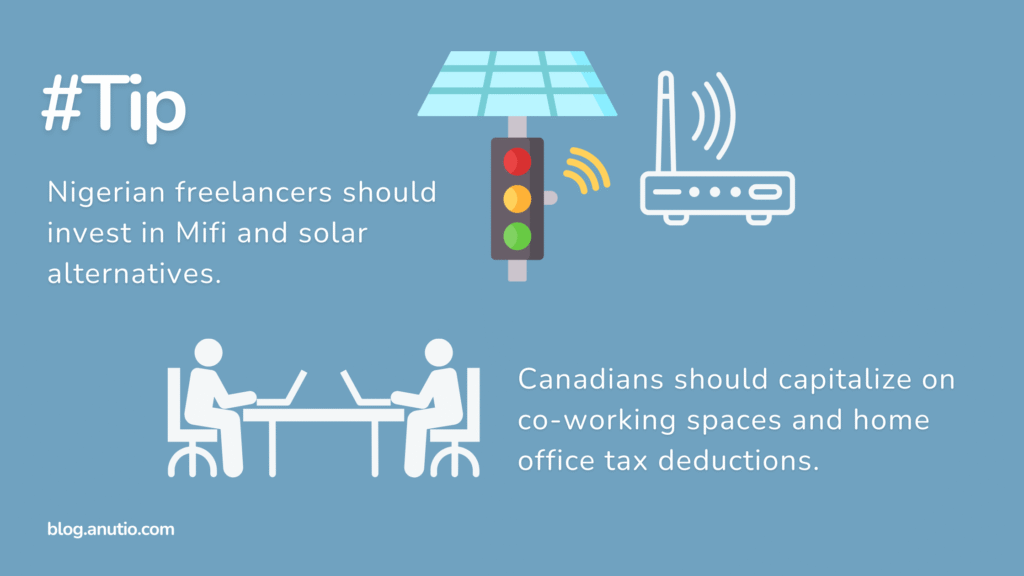
    • Frequent power outages and high generator/diesel costs.
    • Average internet speed: 15 Mbps (Ookla, 2025)
    • Mobile data is expensive relative to income.

    Canada:

    • Uninterrupted power and broadband coverage. High speed fiber is common.
    • Average internet speed: 125 Mbps
    • WiFi is standard in homes, coffee shops, libraries.

    Top Tools for Both:

    • Task Mgmt: Trello, Notion
    • Communication: Slack, Zoom
    • Invoicing: Wave (Canada), Invoicely (Nigeria)

    Lifestyle & Work-Life Balance

    Nigerian Freelancers:

    • Hustle culture dominates, and downtime may feel like a luxury.
    • Extended family expectations.
    • Limited work-life boundaries.

    Canadian Freelancers:

    • Emphasis on boundaries, vacation, and mental health.
    • Government benefits like maternity leave.
    • Stricter legal obligations (contract enforcement, NDAs).

    Extra points: Know your context. A Canadian may enjoy better mental health support but stricter legal boundaries. A Nigerian may enjoy flexibility but with burnout risks.

    • Use time-blocking tools.
    • Join freelancer support groups.

    Skill Development and Freelance Platforms

    Canada:

    • Free courses via Coursera (funded by the government), LinkedIn Learning.

    Nigeria:

    • Platforms like AltSchool Africa, Cousera (free with scholarship), and Skillshare.

    Popular Platforms:

    • Canada: Upwork, Freelancer, Toptal.
    • Nigeria: Fiverr, PeoplePerHour, Turing.

    Health Insurance and Benefits for Freelancers

    Canada:

    • Covered by public health care.
    • Extras (dental, therapy) often require private insurance.

    Nigeria:

    • Freelancers often have no health coverage.
    • Private plans can cost ₦25,000–₦70,000/month.

    Consider HMO plans like AXA Mansard or Reliance HMO

    Freelancer Communities and Networking Opportunities

    Canada:

    • Coworking spaces: WeWork, Staples Studio.
    • Meetups: Startup Grind, TechTO.

    Nigeria:

    • Online hubs: Nairaland Freelance Forum, Twitter Spaces, TechCabal events.
    • Offline events: Lagos Startup Week, Google Developer Groups.

    Challenges and Opportunities in Both Countries

    FactorCanadaNigeria
    Payment IssuesRareFrequent
    Power SupplyStableUnstable
    Client AccessEasier (local + global)Mostly global
    InternetFastIntermittent
    CommunityDiverse and localMostly online

    Case Studies: Canadian Immigrant vs Nigerian Freelancer

    Case Study 1: Aisha – Nigerian Freelancer in Lagos

    • Graphic designer.
    • Earns $2,000/month from US clients.
    • Struggles with power supply and internet.
    • Uses Payoneer for invoicing.

    Case Study 2: Daniel – Nigerian Immigrant in Toronto

    • Web developer.
    • Earns $6,000/month.
    • Pays 27% in taxes.
    • Uses QuickBooks, Stripe, and a CRA-registered GST number.

    How Anutio Helps You Freelance Smarter

    Anutio is not just another Career platform. We offer:

    • Career Mapping: Upload your CV or Resume on our Career Map and get detailed insights into skill suggestions and gaps you might not have been aware of. We ensure you have a complete document for your job applications.
    • Job Matching: We give your clients space to find you. Start building your portfolio through your account to get found.
    • Skill Building: Free webinars, expert guides and bootcamps where you gain access to amazing resources.

    FAQs About Freelancing in Canada vs Nigeria

    Q: Can I freelance from Nigeria for Canadian clients?
    Yes! Use platforms like Upwork or pitch directly. Get paid via Payoneer.

    Q: Do I need a business name in Canada to freelance?
    No, but it’s recommended if you want to register for GST/HST.

    Q: How can I avoid scams as a Nigerian freelancer?
    Use verified platforms, never work without a deposit, and sign contracts.

    Q: How much should I charge as a beginner?
    In Nigeria: $10 – $20/hour. In Canada: $30 – $50/hour.

    Q: Can I freelance in Canada as an immigrant? A: Yes, but ensure you have a valid work permit or PR status.

    Q: What’s the best freelance platform for Nigerians? A: Fiverr and Payoneer-connected Upwork accounts work well.

    Freelancing Isn’t One-Size-Fits-All

    There’s no perfect place to freelance—just different pros and cons depending on where you are and what you need. Canada offers structure, resources, and a higher earning potential. Nigeria offers flexibility, cost savings, and untapped market potential.

    The smart thing? Equip yourself with the right tools.